
Efectele reducerii intensive a greutății asupra compoziției corporale și hormonilor serici la concurentele de fitness
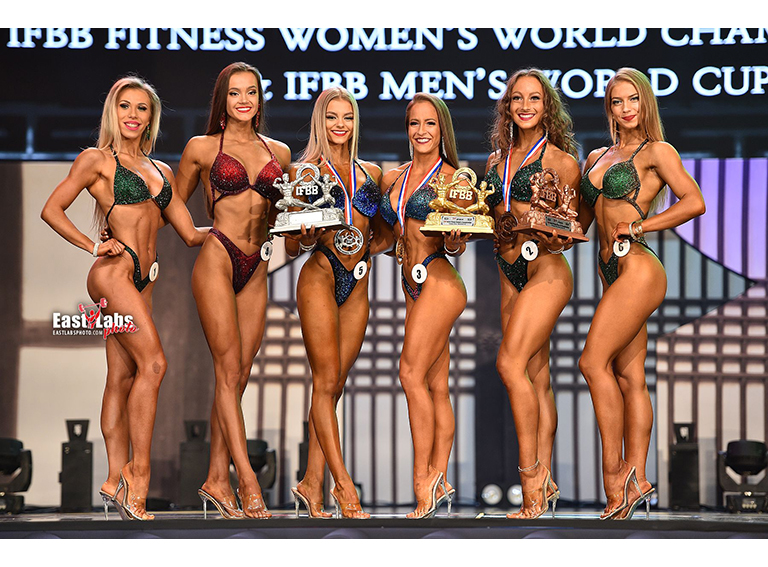
Îngrijorările cu privire la potențialele consecințe negative ale dietelor populare de reducere a grăsimii corporale în scopuri estetice la femeile cu greutate normală au apărut în mass-media. Cu toate acestea, studiile longitudinale care investighează aceste tipuri de diete lipsesc. Scopul acestui studiu a fost de a investiga efectele unei diete de slăbire de 4 luni la femeile cu greutate normală care concurează în sport-fitness.
În total, 50 de participanți au terminat studiul cu 27 de femei (27,2 ± 4,1 ani) ținând dietă pentru o competiție și 23 (27,7 ± 3,7 ani) acționând ca martori stabili în ceea ce privește greutatea.
Deficitul energetic al grupului de dietă a fost atins prin reducerea aportului de carbohidrați și creșterea exercițiilor aerobe, menținând în același timp un nivel ridicat de aport de proteine și antrenament de rezistență pe lângă aportul moderat de grăsimi.
Dieta a condus la o scădere de ~12% a greutății corporale (P < 0,001) și la o scădere de ~35-50% a masei de grăsime (DXA, bioimpedanță, pliuri cutanate, P < 0,001), în timp ce grupul de control și-a menținut masa corporală și de grăsime ( dieta × interacțiune de grup P < 0,001).
O mică scădere a masei slabe (bioimpedanță și pliuri ale pielii) și a secțiunii transversale a mușchiului vastus lateralis (ultrasunete) a fost observată în dietă (P < 0,05), în timp ce alte rezultate au fost nemodificate (DXA: masă slabă, ultrasunete: grosimea lui triceps brachii).
Sistemul hormonal a fost modificat în timpul dietei cu scăderea concentrațiilor serice de leptină, triiodotironină (T3), testosteron (P < 0,001) și estradiol (P < 0,01) coincide cu o incidență crescută a neregulilor menstruale (P < 0,05).
Greutatea corporală și toți hormonii, cu excepția T3 și testosteronul, au revenit la valoarea inițială în timpul unei perioade de recuperare de 3-4 luni, inclusiv aportul crescut de energie și scăderea nivelului de exerciții aerobice.
Acest studiu arată pentru prima dată că majoritatea modificărilor hormonale după o scădere cu 35-50% a grăsimii corporale la femeile cu greutate normală anterior se pot recupera în 3-4 luni de la un aport crescut de energie.
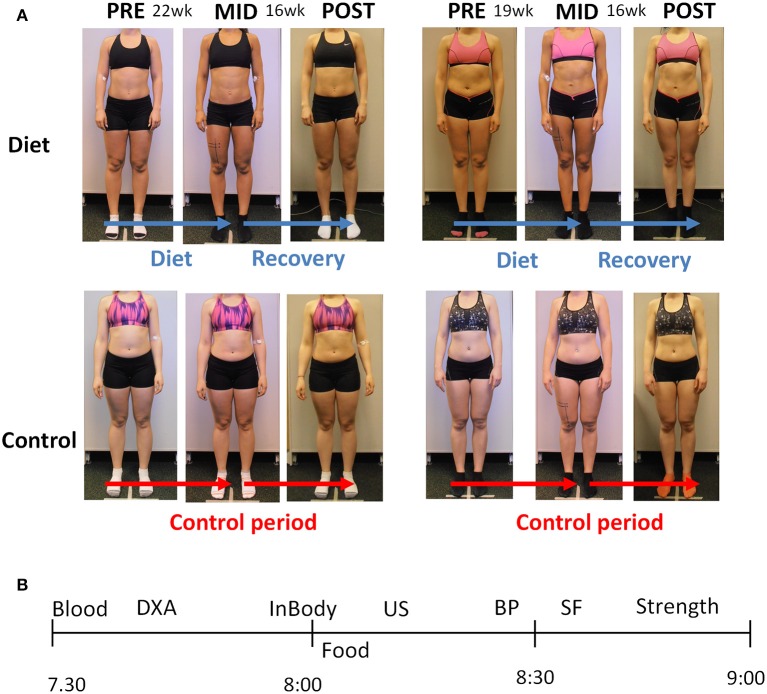
Figura 1 (A) Designul experimental al studiului. Din fiecare grup sunt afișați doi participanți reprezentativi. Perioada de timp anterioară și mijlocie a durat aproximativ 20 de săptămâni, timp în care participanții și-au scăzut aportul de energie și cantitatea de exerciții fizice (vezi secțiunea Rezultate), în timp ce controalele și-au menținut nivelurile de activitate și aportul de nutrienți. Perioada de la mijlocul până la dieta, care a durat aproximativ 18 săptămâni, a fost o perioadă de recuperare cu un aport de energie crescut înapoi la nivelurile de bază ale participanților la dietă, în timp ce controalele și-au menținut aportul de energie și nivelurile de efort (vezi secțiunea Rezultate).
(B) Exemplul zilei de măsurare pentru fiecare participant. Axa x reprezintă ora AM (dimineața). Sânge, probă de sânge; DXA, Absorbțiometrie cu raze X cu energie duală; InBody, impedanță bioelectrică; Mâncare, mic dejun; US, ecografie; TA, tensiunea arterială; SF, pliuri ale pielii; Măsurători de forță, forță musculară.
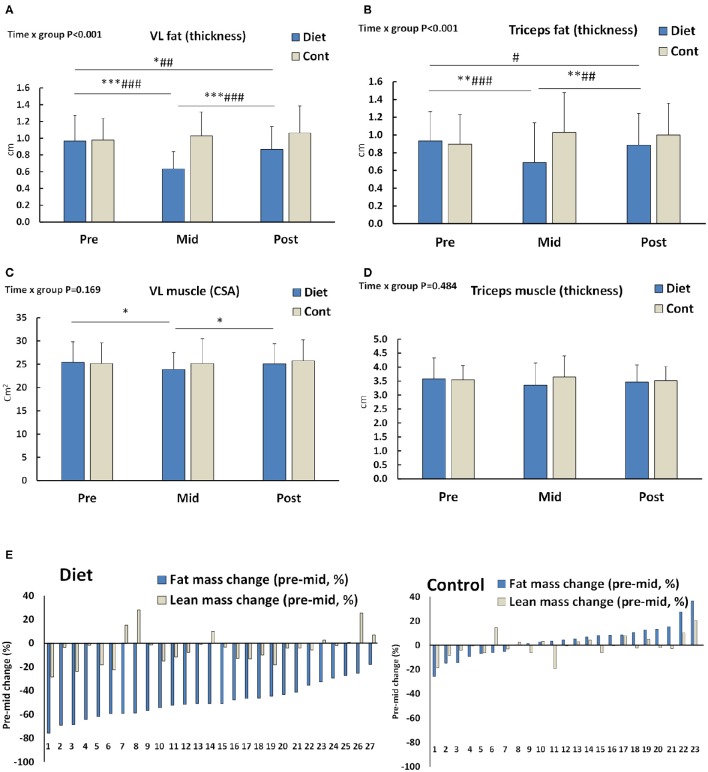
Figura 2 (A, B) Grosimea grăsimii subcutanate în jurul muschilor Vastus lateralis (VL) și triceps brachii (n = 25-27 de dietă și 19-20 de participanți de control).
(C, D) Aria secțiunii transversale a mușchilor VL (CSA) și grosimea mușchilor triceps brachii (n = 27 de participanți la dietă și 20 de participanți de control).
(E) Modificări individuale ale procentului de grăsime și masă slabă în timpul dietei sau perioadei de control înainte și mijlocie. Numărul de pe axa x prezintă numerele de participanți ordonate în funcție de cantitatea de grăsime pierdută. Valorile DXA și bioimpedanța sunt mediate (n = 27 de participanți la dietă și 23 de participanți de control). ***** este semnificativă (p < 0,05–< 0,001) diferența față de Pre și #–### este semnificativă (p < 0,05–< 0,001) diferența dintre grupurile din modificare. Grup × timp = valoarea p efectului interacțiunii ANOVA.
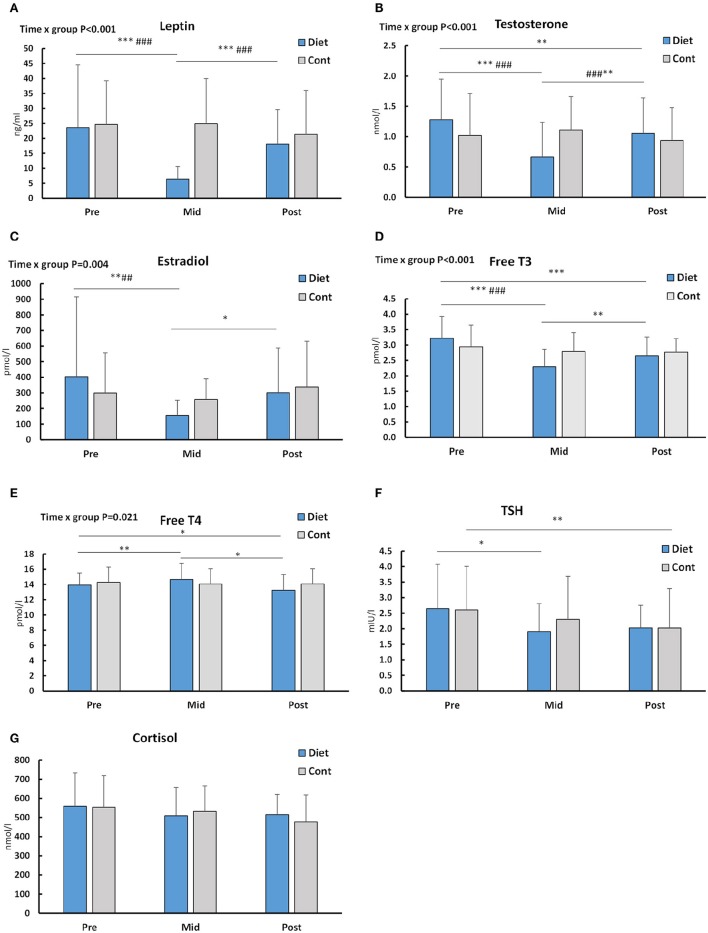
Figura 3 Concentrațiile serice de hormoni la momentul inițial (Pre), după dieta/perioada de control (Mid) și după aceea în perioada de recuperare (Post). Din panourile individuale, (A) descrie leptina, (B) testosteron, (C) estradiol, (D) T3 liber, (E) T4 liber, (F) TSH și (G) cortizol. n = 27 de participanți la dietă și 23 de control pentru toți hormonii, cu excepția datelor privind TSH și testosteron, care sunt obținute de la 22 de control. ***** este semnificativă (p < 0,05–< 0,001) diferența față de Pre și #–### este semnificativă (p < 0,05–< 0,001) diferența dintre grupurile din modificare. Sunt prezentate valorile p semnificative (p < 0,05) grup × timp = efectul de interacțiune ANOVA. Pentru TSH și cortizol nu au existat efecte de interacțiune semnificative (p = 0,198 și, respectiv, p = 0,332).
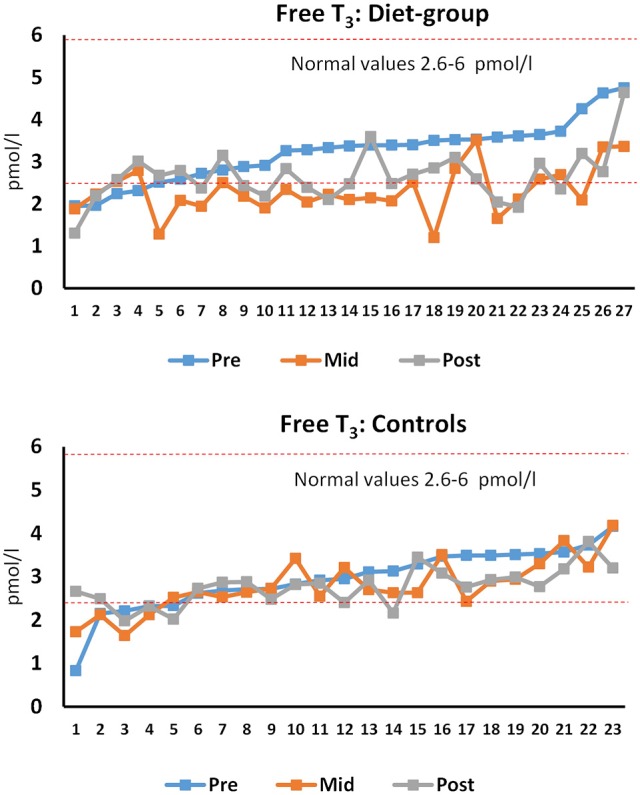
Figura 4 T3 individual liber la punctele de timp pre, mijloc și post pentru participanții la dietă și control. Numărul de pe axa x reprezintă numerele de participanți ordonate pe baza valorii prealabile. Liniile punctate roșii limitează valorile de referință la femelele sănătoase cu greutate normală. n = 27 de participanți la dietă și 23 de control.
Adaptare Bitanu-Alexandru
References
- Ahtiainen J. P., Hoffren M., Hulmi J. J., Pietikäinen M., Mero A. A., Avela J., et al. . (2010). Panoramic ultrasonography is a valid method to measure changes in skeletal muscle cross-sectional area. Eur. J. Appl. Physiol. 108, 273–279. 10.1007/s00421-009-1211-6 – DOI – PubMed
- Ainsworth B. E., Haskell W. L., Whitt M. C., Irwin M. L., Swartz A. M., Strath S. J., et al. . (2000). Compendium of physical activities: an update of activity codes and MET intensities. Med. Sci. Sports Exerc. 32, S498–S504. 10.1097/00005768-200009001-00009 – DOI – PubMed
- Alemany J. A., Nindl B. C., Kellogg M. D., Tharion W. J., Young A. J., Montain S. J. (2008). Effects of dietary protein content on IGF-I, testosterone, and body composition during 8 days of severe energy deficit and arduous physical activity. J. Appl. Physiol. (1985) 105, 58–64. 10.1152/japplphysiol.00005.2008 – DOI – PubMed
- Arciero P. J., Ormsbee M. J., Gentile C. L., Nindl B. C., Brestoff J. R., Ruby M. (2013). Increased protein intake and meal frequency reduces abdominal fat during energy balance and energy deficit. Obesity (Silver Spring) 21, 1357–1366. 10.1002/oby.20296 – DOI – PubMed
- Awazu M., Matsuoka S., Kamimaki T., Watanabe H., Matsuo N. (2000). Absent circadian variation of blood pressure in patients with anorexia nervosa. J. Pediatr. 136, 524–527. 10.1016/S0022-3476(00)90017-9 – DOI – PubMed
- Bamman M. M., Hunter G. R., Newton L. E., Roney R. K., Khaled M. A. (1993). Changes in body composition, diet, and strength of bodybuilders during the 12 weeks prior to competition. J. Sports Med. Phys. Fitness 33, 383–391. – PubMed
- Chan J. L., Matarese G., Shetty G. K., Raciti P., Kelesidis I., Aufiero D., et al. . (2006). Differential regulation of metabolic, neuroendocrine, and immune function by leptin in humans. Proc. Natl. Acad. Sci. U.S.A. 103, 8481–8486. 10.1073/pnas.0505429103 – DOI – PMC – PubMed
- Churchward-Venne T. A., Murphy C. H., Longland T. M., Phillips S. M. (2013). Role of protein and amino acids in promoting lean mass accretion with resistance exercise and attenuating lean mass loss during energy deficit in humans. Amino Acids 45, 231–240. 10.1007/s00726-013-1506-0 – DOI – PubMed
- Davis S. R., McCloud P., Strauss B. J., Burger H. (1995). Testosterone enhances estradiol’s effects on postmenopausal bone density and sexuality. Maturitas 21, 227–236. 10.1016/0378-5122(94)00898-H – DOI – PubMed
- Dulloo A. G., Jacquet J., Girardier L. (1996). Autoregulation of body composition during weight recovery in human: the Minnesota Experiment revisited. Int. J. Obes. Relat. Metab. Disord. 20, 393–405. – PubMed
- Durnin J. V., Womersley J. (1974). Body fat assessed from total body density and its estimation from skinfold thickness: measurements on 481 men and women aged from 16 to 72 years. Br. J. Nutr. 32, 77–97. 10.1079/BJN19740060 – DOI – PubMed
- Fothergill E., Guo J., Howard L., Kerns J. C., Knuth N. D., Brychta R., et al. . (2016). Persistent metabolic adaptation 6 years after “The Biggest Loser” competition. Obesity (Silver Spring) 24, 1612–1619. 10.1002/oby.21538 – DOI – PMC – PubMed
- Goodman C. A., Hornberger T. A., Robling A. G. (2015). Bone and skeletal muscle: key players in mechanotransduction and potential overlapping mechanisms. Bone 80, 24–36. 10.1016/j.bone.2015.04.014 – DOI – PMC – PubMed
- Hackett D. A., Johnson N. A., Chow C. M. (2013). Training practices and ergogenic aids used by male bodybuilders. J. Strength Cond. Res. 27, 1609–1617. 10.1519/JSC.0b013e318271272a – DOI – PubMed
- Häkkinen K., Kallinen M. (1994). Distribution of strength training volume into one or two daily sessions and neuromuscular adaptations in female athletes. Electromyogr. Clin. Neurophysiol. 34, 117–124. – PubMed
- Häkkinen K., Pakarinen A., Kallinen M. (1992). Neuromuscular adaptations and serum hormones in women during short-term intensive strength training. Eur. J. Appl. Physiol. Occup. Physiol. 64, 106–111. 10.1007/BF00717946 – DOI – PubMed
- Haring R., Hannemann A., John U., Radke D., Nauck M., Wallaschofski H., et al. . (2012). Age-specific reference ranges for serum testosterone and androstenedione concentrations in women measured by liquid chromatography-tandem mass spectrometry. J. Clin. Endocrinol. Metab. 97, 408–415. 10.1210/jc.2011-2134 – DOI – PubMed
- Helms E. R., Aragon A. A., Fitschen P. J. (2014). Evidence-based recommendations for natural bodybuilding contest preparation: nutrition and supplementation. J. Int. Soc. Sports Nutr. 11:20. 10.1186/1550-2783-11-20 – DOI – PMC – PubMed
- Helms E. R., Fitschen P. J., Aragon A. A., Cronin J., Schoenfeld B. J. (2015). Recommendations for natural bodybuilding contest preparation: resistance and cardiovascular training. J. Sports Med. Phys. Fitness 55, 164–178. – PubMed
- Henning P. C., Scofield D. E., Spiering B. A., Staab J. S., Matheny R. W., Jr., Smith M. A., et al. . (2014). Recovery of endocrine and inflammatory mediators following an extended energy deficit. J. Clin. Endocrinol. Metab. 99, 956–964. 10.1210/jc.2013-3046 – DOI – PubMed
- Hill A. M., LaForgia J., Coates A. M., Buckley J. D., Howe P. R. (2007). Estimating abdominal adipose tissue with DXA and anthropometry. Obesity (Silver Spring) 15, 504–510. 10.1038/oby.2007.629 – DOI – PubMed
- Hulmi J. J., Laakso M., Mero A. A., Häkkinen K., Ahtiainen J. P., Peltonen H. (2015). The effects of whey protein with or without carbohydrates on resistance training adaptations. J. Int. Soc. Sports Nutr. 12:48. 10.1186/s12970-015-0109-4 – DOI – PMC – PubMed
- Huovinen H. T., Hulmi J. J., Isolehto J., Kyröläinen H., Puurtinen R., Karila T., et al. . (2015). Body composition and power performance improved after weight reduction in male athletes without hampering hormonal balance. J. Strength Cond. Res. 29, 29–36. 10.1519/JSC.0000000000000619 – DOI – PubMed
- Ihle R., Loucks A. B. (2004). Dose-response relationships between energy availability and bone turnover in young exercising women. J. Bone Miner. Res. 19, 1231–1240. 10.1359/JBMR.040410 – DOI – PubMed
- Josse A. R., Atkinson S. A., Tarnopolsky M. A., Phillips S. M. (2011). Increased consumption of dairy foods and protein during diet- and exercise-induced weight loss promotes fat mass loss and lean mass gain in overweight and obese premenopausal women. J. Nutr. 141, 1626–1634. 10.3945/jn.111.141028 – DOI – PMC – PubMed
- Kang S. M., Yoon J. W., Ahn H. Y., Kim S. Y., Lee K. H., Shin H., et al. . (2011). Android fat depot is more closely associated with metabolic syndrome than abdominal visceral fat in elderly people. PLoS ONE 6:e27694. 10.1371/journal.pone.0027694 – DOI – PMC – PubMed
- Kelesidis T., Kelesidis I., Chou S., Mantzoros C. S. (2010). Narrative review: the role of leptin in human physiology: emerging clinical applications. Ann. Intern. Med. 152, 93–100. 10.7326/0003-4819-152-2-201001190-00008 – DOI – PMC – PubMed
- Keys A., Brozek J., Henschel A., Mickelsen O., Taylor H. (1950). The Biology of Human Starvation. Minneapolis, MN: The University of Minnesota Press.
- Kim B. (2008). Thyroid hormone as a determinant of energy expenditure and the basal metabolic rate. Thyroid 18, 141–144. 10.1089/thy.2007.0266 – DOI – PubMed
- Kistler B. M., Fitschen P. J., Ranadive S. M., Fernhall B., Wilund K. R. (2014). Case study: natural bodybuilding contest preparation. Int. J. Sport Nutr. Exerc. Metab. 24, 694–700. 10.1123/ijsnem.2014-0016 – DOI – PubMed
- Komi P. V., Bosco C. (1978). Utilization of stored elastic energy in leg extensor muscles by men and women. Med. Sci. Sports 10, 261–265. – PubMed
- Kraemer W. J., Volek J. S., Clark K. L., Gordon S. E., Puhl S. M., Koziris L. P., et al. . (1999). Influence of exercise training on physiological and performance changes with weight loss in men. Med. Sci. Sports Exerc. 31, 1320–1329. 10.1097/00005768-199909000-00014 – DOI – PubMed
- Longland T. M., Oikawa S. Y., Mitchell C. J., Devries M. C., Phillips S. M. (2016). Higher compared with lower dietary protein during an energy deficit combined with intense exercise promotes greater lean mass gain and fat mass loss: a randomized trial. Am. J. Clin. Nutr. 103, 738–746. 10.3945/ajcn.115.119339 – DOI – PubMed
- Mehta T., Smith D. L., Jr., Muhammad J., Casazza K. (2014). Impact of weight cycling on risk of morbidity and mortality. Obes. Rev. 15, 870–881. 10.1111/obr.12222 – DOI – PMC – PubMed
- Melin A., Tornberg Å. B., Skouby S., Møller S. S., Sundgot-Borgen J., Faber J., et al. . (2015). Energy availability and the female athlete triad in elite endurance athletes. Scand. J. Med. Sci. Sports 25, 610–622. 10.1111/sms.12261 – DOI – PubMed
- Mero A. A., Huovinen H., Matintupa O., Hulmi J. J., Puurtinen R., Hohtari H., et al. . (2010). Moderate energy restriction with high protein diet results in healthier outcome in women. J. Int. Soc. Sports Nutr. 7:4. 10.1186/1550-2783-7-4 – DOI – PMC – PubMed
- Mettler S., Mitchell N., Tipton K. D. (2010). Increased protein intake reduces lean body mass loss during weight loss in athletes. Med. Sci. Sports Exerc. 42, 326–337. 10.1249/MSS.0b013e3181b2ef8e – DOI – PubMed
- Meyer N. L., Sundgot-Borgen J., Lohman T. G., Ackland T. R., Stewart A. D., Maughan R. J., et al. . (2013). Body composition for health and performance: a survey of body composition assessment practice carried out by the Ad Hoc Research Working Group on Body Composition, Health and Performance under the auspices of the IOC Medical Commission. Br. J. Sports Med. 47, 1044–1053. 10.1136/bjsports-2013-092561 – DOI – PubMed
- Miazgowski T., Krzyzanowska-Swiniarska B., Dziwura-Ogonowska J., Widecka K. (2014). The associations between cardiometabolic risk factors and visceral fat measured by a new dual-energy X-ray absorptiometry-derived method in lean healthy Caucasian women. Endocrine 47, 500–505. 10.1007/s12020-014-0180-7 – DOI – PMC – PubMed
- Miller C. T., Fraser S. F., Levinger I., Straznicky N. E., Dixon J. B., Reynolds J., et al. . (2013). The effects of exercise training in addition to energy restriction on functional capacities and body composition in obese adults during weight loss: a systematic review. PLoS ONE 8:e81692. 10.1371/journal.pone.0081692 – DOI – PMC – PubMed
- Miller K. K., Lawson E. A., Mathur V., Wexler T. L., Meenaghan E., Misra M., et al. . (2007). Androgens in women with anorexia nervosa and normal-weight women with hypothalamic amenorrhea. J. Clin. Endocrinol. Metab. 92, 1334–1339. 10.1210/jc.2006-2501 – DOI – PMC – PubMed
- Müller M. J., Enderle J., Pourhassan M., Braun W., Eggeling B., Lagerpusch M., et al. . (2015). Metabolic adaptation to caloric restriction and subsequent refeeding: the Minnesota Starvation Experiment revisited. Am. J. Clin. Nutr. 102, 807–819. 10.3945/ajcn.115.109173 – DOI – PubMed
- Müller W., Lohman T. G., Stewart A. D., Maughan R. J., Meyer N. L., Sardinha L. B., et al. . (2016). Subcutaneous fat patterning in athletes: selection of appropriate sites and standardisation of a novel ultrasound measurement technique: ad hoc working group on body composition, health and performance, under the auspices of the IOC Medical Commission. Br. J. Sports Med. 50, 45–54. 10.1136/bjsports-2015-095641 – DOI – PMC – PubMed
- Muñoz M. T., Morandé G., García-Centenera J. A., Hervás F., Pozo J., Argente J. (2002). The effects of estrogen administration on bone mineral density in adolescents with anorexia nervosa. Eur. J. Endocrinol. 146, 45–50. 10.1530/eje.0.1460045 – DOI – PubMed
- Newton L., Hunter G., Bammon M., Roney R. (1993). Changes in psychological state and self-reported diet during various phases of training in competitive bodybuilders. J. Strength Cond. Res. 7, 153–158. 10.1519/00124278-199308000-00005 – DOI
- Ojasto T., Häkkinen K. (2009). Effects of different accentuated eccentric load levels in eccentric-concentric actions on acute neuromuscular, maximal force, and power responses. J. Strength Cond. Res. 23, 996–1004. 10.1519/JSC.0b013e3181a2b28e – DOI – PubMed
- Pasiakos S. M., Cao J. J., Margolis L. M., Sauter E. R., Whigham L. D., McClung J. P., et al. . (2013). Effects of high-protein diets on fat-free mass and muscle protein synthesis following weight loss: a randomized controlled trial. FASEB J. 27, 3837–3847. 10.1096/fj.13-230227 – DOI – PubMed
- Rickenlund A., Carlström K., Ekblom B., Brismar T. B., von Schoultz B., Hirschberg A. L. (2003). Hyperandrogenicity is an alternative mechanism underlying oligomenorrhea or amenorrhea in female athletes and may improve physical performance. Fertil. Steril. 79, 947–955. 10.1016/S0015-0282(02)04850-1 – DOI – PubMed
- Robinson S. L., Lambeth-Mansell A., Gillibrand G., Smith-Ryan A., Bannock L. (2015). A nutrition and conditioning intervention for natural bodybuilding contest preparation: case study. J. Int. Soc. Sports Nutr. 12:20. 10.1186/s12970-015-0083-x – DOI – PMC – PubMed
- Rosenbaum M., Murphy E. M., Heymsfield S. B., Matthews D. E., Leibel R. L. (2002). Low dose leptin administration reverses effects of sustained weight-reduction on energy expenditure and circulating concentrations of thyroid hormones. J. Clin. Endocrinol. Metab. 87, 2391–2394. 10.1210/jcem.87.5.8628 – DOI – PubMed
- Rossow L. M., Fukuda D. H., Fahs C. A., Loenneke J. P., Stout J. R. (2013). Natural bodybuilding competition preparation and recovery: a 12-month case study. Int. J. Sports Physiol. Perform. 8, 582–592. 10.1123/ijspp.8.5.582 – DOI – PubMed
- Saarni S. E., Rissanen A., Sarna S., Koskenvuo M., Kaprio J. (2006). Weight cycling of athletes and subsequent weight gain in middleage. Int. J. Obes. (Lond). 30, 1639–1644. 10.1038/sj.ijo.0803325 – DOI – PubMed
- Sachs K. V., Harnke B., Mehler P. S., Krantz M. J. (2016). Cardiovascular complications of anorexia nervosa: a systematic review. Int. J. Eat. Disord. 49, 238–248. 10.1002/eat.22481 – DOI – PubMed
- Sandoval W. M., Heyward V. H., Lyons T. M. (1989). Comparison of body composition, exercise and nutritional profiles of female and male body builders at competition. J. Sports Med. Phys. Fitness 29, 63–70. – PubMed
- Schumann M., Küüsmaa M., Newton R. U., Sirparanta A. I., Syväoja H., Häkkinen A., et al. . (2014). Fitness and lean mass increases during combined training independent of loading order. Med. Sci. Sports Exerc. 46, 1758–1768. 10.1249/MSS.0000000000000303 – DOI – PubMed
- Sundgot-Borgen J., Meyer N. L., Lohman T. G., Ackland T. R., Maughan R. J., Stewart A. D., et al. . (2013). How to minimise the health risks to athletes who compete in weight-sensitive sports review and position statement on behalf of the Ad Hoc Research Working Group on Body Composition, Health and Performance, under the auspices of the IOC Medical Commission. Br. J. Sports Med. 47, 1012–1022. 10.1136/bjsports-2013-092966 – DOI – PubMed
- Terry P. C., Lane A. M., Lane H. J., Keohane L. (1999). Development and validation of a mood measure for adolescents. J. Sports Sci. 17, 861–872. 10.1080/026404199365425 – DOI – PubMed
- Tolle V., Kadem M., Bluet-Pajot M. T., Frere D., Foulon C., Bossu C., et al. . (2003). Balance in ghrelin and leptin plasma levels in anorexia nervosa patients and constitutionally thin women. J. Clin. Endocrinol. Metab. 88, 109–116. 10.1210/jc.2002-020645 – DOI – PubMed
- Tomiyama A. J., Mann T., Vinas D., Hunger J. M., Dejager J., Taylor S. E. (2010). Low calorie dieting increases cortisol. Psychosom. Med. 72, 357–364. 10.1097/PSY.0b013e3181d9523c – DOI – PMC – PubMed
- van der Ploeg G. E., Brooks A. G., Withers R. T., Dollman J., Leaney F., Chatterton B. E. (2001). Body composition changes in female bodybuilders during preparation for competition. Eur. J. Clin. Nutr. 55, 268–277. 10.1038/sj.ejcn.1601154 – DOI – PubMed
- Verheggen R. J., Maessen M. F., Green D. J., Hermus A. R., Hopman M. T., Thijssen D. H. (2016). A systematic review and meta-analysis on the effects of exercise training versus hypocaloric diet: distinct effects on body weight and visceral adipose tissue. Obes. Rev. 17, 664–690. 10.1111/obr.12406 – DOI – PubMed
- Vuoskoski J. K., Eerola T. (2011). The role of mood and personality in the perception of emotions represented by music. Cortex 47, 1099–1106. 10.1016/j.cortex.2011.04.011 – DOI – PubMed
- Wilmore J. H., Brown C. H., Davis J. A. (1977). Body physique and composition of the female distance runner. Ann. N.Y. Acad. Sci. 301, 764–776. 10.1111/j.1749-6632.1977.tb38245.x – DOI – PubMed